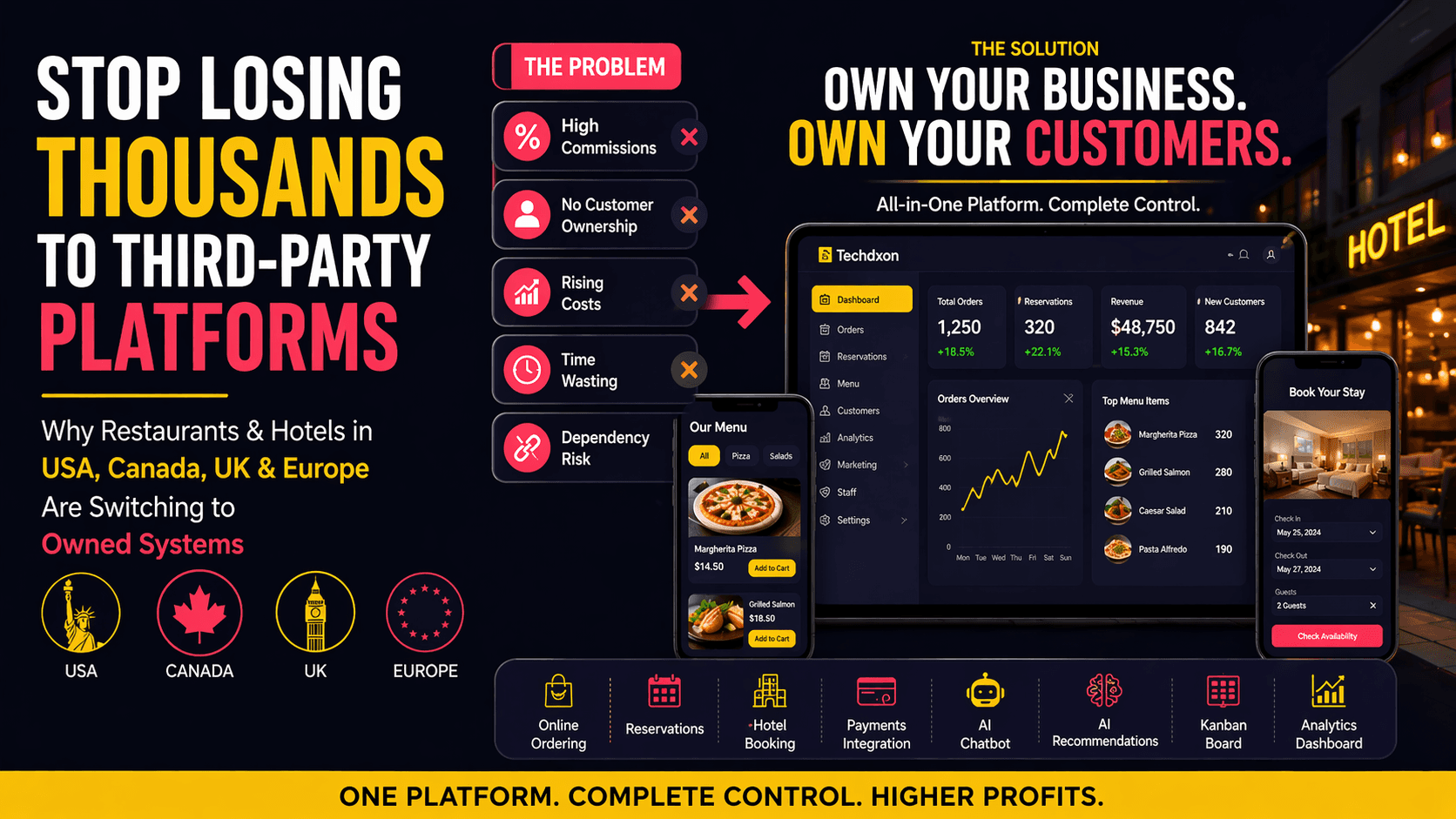
How Restaurants and Hotels Can Move Away From Third-Party Platforms
1. Introduction: A Structural Shift in Hospitality Technology
Over the last decade, restaurants and hotels in regions such as the United States, Canada, the United Kingdom, Germany, Spain, and other parts of Europe have increasingly relied on third-party platforms for core operations. These platforms include food delivery marketplaces, reservation systems, and hotel booking aggregators.
At first, this shift solved real problems: faster customer acquisition, simplified booking flows, and reduced need for in-house software development.
However, as these platforms became dominant, a structural dependency problem emerged. Many hospitality businesses now operate without direct control over their own customers, data, pricing systems, or even brand experience.
This article breaks down the real operational, financial, and strategic issues caused by third-party dependence and explores how modern unified systems can replace fragmented tools with owned infrastructure.
2. The Core Dependency Problem in Modern Hospitality
Across most developed markets, hospitality businesses now depend on multiple external platforms:
- Food delivery apps for online orders
- Reservation platforms for table bookings
- Hotel aggregators for room bookings
- Payment gateways and POS integrations spread across vendors
This creates a fragmented digital ecosystem.
The main issue is not the existence of these platforms. The issue is loss of ownership and control over the customer journey.
Key consequences include:
- Businesses do not own customer data
- Repeat customers are retained by platforms, not restaurants or hotels
- Commission fees reduce long-term profitability
- Brand identity is diluted within marketplace interfaces
- Operational complexity increases due to multiple dashboards
3. Financial Impact: The Hidden Cost of Third-Party Platforms
One of the most significant challenges faced by hospitality businesses in the USA, Canada, UK, and Europe is cost structure.
Most third-party platforms operate on commission-based models:
- Food delivery platforms: 15% to 35% per order
- Hotel booking platforms: 10% to 25% per reservation
- Reservation systems: subscription fees plus per-seat charges
The long-term effect
For a restaurant generating $50,000 monthly revenue:
- 20% average commission equals $10,000 lost monthly
- Annual loss exceeds $120,000
For hotels, the situation is similar. High occupancy rates often translate into high platform dependency, which reduces profit margins significantly over time.
These costs are not always visible upfront, which is why they are often referred to as "hidden operational taxes."
4. Operational Inefficiency Caused by Fragmented Systems
Beyond cost, there is a major operational issue: fragmentation.
Most businesses use separate systems for:
- Online ordering
- Table reservations
- Menu updates
- Staff coordination
- Customer tracking
- Payment processing
This leads to:
- Duplicate data entry
- Human error in order handling
- Delayed updates across platforms
- Training complexity for staff
- Lack of centralized reporting
Restaurants in high-volume cities such as New York, Toronto, London, and Madrid often struggle to synchronize real-time operations across these systems.
Hotels face similar issues when managing bookings across multiple OTAs (online travel agencies).
5. The Shift Toward Owned Digital Infrastructure
A growing trend across hospitality technology is the shift from platform dependency to owned systems.
Instead of relying on multiple external services, businesses are now adopting unified systems that include:
- Direct ordering systems
- In-house reservation engines
- Custom hotel booking platforms
- Centralized content management systems
- Integrated payment processing
This shift represents a transition from "renting customers" to "owning customers."
6. What a Unified Hospitality System Looks Like
Modern platforms are no longer just websites. They are full operational ecosystems.
A complete system typically includes:
Restaurant functionality
- Online ordering system (direct-to-business)
- Dynamic menu management system
- Table reservation engine
- Pickup and delivery scheduling
- Payment gateway integration
- Customer history tracking
Hotel functionality
- Room booking engine
- Availability calendar system
- Seasonal pricing control
- Direct reservation handling
- Guest profile management
Business management layer
- Centralized CMS
- Order tracking system
- Staff and role management
- Analytics dashboard
- Workflow management tools (including Kanban-style boards)
7. AI Integration in Modern Hospitality Platforms
A key evolution in hospitality technology is the integration of artificial intelligence into daily operations.
Instead of static systems, modern platforms now include AI-powered assistance layers.
AI capabilities include:
1. Customer support chatbots
AI chat systems can handle:
- Reservation queries
- Order tracking
- Menu questions
- Booking modifications
This reduces dependency on front desk staff for repetitive tasks.
2. AI recommendation systems
Systems can suggest:
- Menu items based on user behavior
- Room upgrades based on booking history
- Personalized offers and discounts
3. Operational insights
AI can analyze:
- Peak order times
- Popular menu items
- Seasonal demand trends
- Staff workload distribution
4. Smart automation
- Auto-confirmation of reservations
- Dynamic pricing suggestions for hotels
- Inventory-aware menu adjustments
This reduces manual decision-making and improves efficiency across operations.
8. Why Businesses Are Moving Away From Third-Party Platforms
The transition is not purely technical. It is strategic.
Key drivers:
Ownership of customer data
Businesses want direct access to their customers for:
- Marketing
- Retention
- Loyalty programs
Profit margin recovery
Removing commission-based platforms restores lost revenue.
Brand control
Restaurants and hotels can fully control:
- User experience
- UI/UX design
- Communication flow
Operational simplicity
A unified system reduces the need for multiple tools and integrations.
9. Example of a Unified System Approach
Instead of using:
- UberEats for delivery
- OpenTable for reservations
- External CMS for menu updates
- Separate POS system for billing
A unified system combines all functions into a single platform.
This reduces operational overhead and improves consistency across customer touchpoints.
10. Techdxon Approach to Unified Hospitality Systems
Platforms like Techdxon focus on replacing fragmented hospitality stacks with integrated systems that combine website infrastructure, CMS capabilities, and operational tools.
Key components include:
- Full website + CMS system for restaurants and hotels
- Online ordering and reservation modules
- Payment gateway integration
- Admin dashboards for operations
- AI-assisted customer interaction tools
This approach is designed to help businesses move from dependency-based operations to owned digital ecosystems.
More information:
11. Geographic Relevance: USA, Canada, UK, and Europe
The shift toward owned systems is particularly strong in:
- United States: high delivery platform penetration and high commission sensitivity
- Canada: growing restaurant digitization with increasing operational costs
- United Kingdom: strong adoption of reservation platforms now being re-evaluated
- Europe: multi-language and multi-market complexity requiring centralized control
In all these regions, businesses are increasingly prioritizing long-term sustainability over short-term platform convenience.
12. Conclusion: From Platform Dependency to Digital Ownership
The hospitality industry is undergoing a structural transition.
The question is no longer whether third-party platforms are useful. They are.
The question is whether long-term dependency on them is sustainable.
The emerging direction is clear:
- Reduce fragmentation
- Centralize operations
- Own customer data
- Integrate AI into workflows
- Build independent digital infrastructure
Businesses that adopt this model early are likely to achieve stronger margins, better operational control, and improved customer relationships over time.