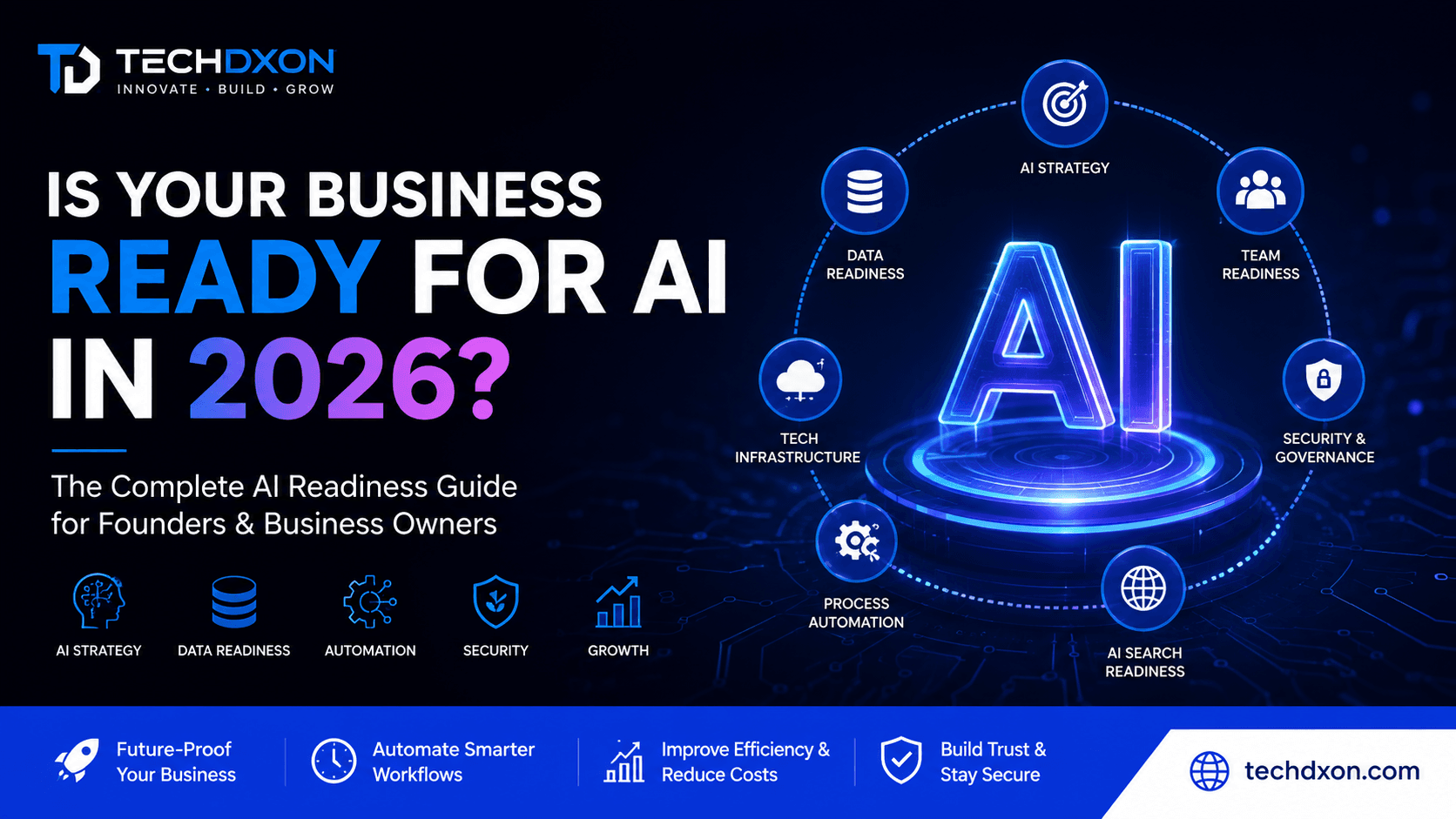
Is Your Business Ready for AI in 2026?
AI is no longer a competitive advantage.
It is becoming the minimum requirement for staying competitive.
Whether you run a startup, an established company, an ecommerce brand, a SaaS platform, or a service business, one question will define your growth over the next few years:
Is your business actually ready for AI?
Many organizations believe using ChatGPT occasionally or installing an AI chatbot means they have adopted artificial intelligence.
Unfortunately, that's far from reality.
True AI readiness goes much deeper.
It includes:
- Leadership strategy
- Business processes
- Data quality
- Technology infrastructure
- Team capabilities
- Security
- Governance
- Customer experience
- Website optimization
- AI Search visibility
Businesses that prepare today will reduce operational costs, automate repetitive work, improve customer satisfaction, and unlock entirely new revenue opportunities.
Businesses that delay may find themselves losing market share to faster, AI-enabled competitors.
In this guide, we'll help you evaluate your company's AI readiness using a practical framework designed for founders, business owners, and startup leaders.
Table of Contents
- Why AI Readiness Matters More Than Ever
- What AI Readiness Actually Means
- Signs Your Business Is Not AI Ready
- The 8 Pillars of AI Readiness
- AI Readiness Checklist
- Common Mistakes Companies Make
- How TechDxon Helps Businesses Become AI Ready
- Frequently Asked Questions
Why AI Readiness Matters in 2026
Artificial intelligence has evolved dramatically over the last few years.
Businesses are now using AI to:
- Generate content
- Automate customer support
- Analyze business data
- Forecast sales
- Detect fraud
- Build software faster
- Improve marketing campaigns
- Optimize operations
- Manage inventory
- Personalize customer experiences
- Assist employees
- Create internal knowledge bases
- Build AI agents
This isn't limited to large enterprises anymore.
Small businesses are adopting AI faster than ever because modern AI tools are significantly more affordable and easier to implement.
The question is no longer:
"Should we use AI?"
Instead, the question has become:
"How prepared are we to successfully implement AI?"
AI Is Changing Search, Too
Another major shift is happening in how customers discover businesses online.
Traditional SEO is still important, but users are increasingly finding answers through AI-powered search experiences such as:
- Google AI Overviews
- ChatGPT
- Perplexity
- Claude
- Gemini
- Microsoft Copilot
Instead of clicking through multiple websites, users now receive direct, synthesized answers.
That means businesses need to optimize not only for search engines but also for AI systems that summarize and recommend content.
This is where concepts like:
- Answer Engine Optimization (AEO)
- AI Optimization (AIO)
- Generative Engine Optimization (GEO)
are becoming increasingly important.
Companies that produce authoritative, structured, trustworthy, and experience-driven content are more likely to appear in AI-generated responses.
What Does "AI Ready" Actually Mean?
Being AI ready doesn't mean purchasing expensive software.
It means your organization has the foundation required for AI to produce measurable business value.
An AI-ready business typically has:
✅ Clear business goals
✅ Reliable business data
✅ Modern digital infrastructure
✅ Secure systems
✅ Well-documented processes
✅ Leadership support
✅ Employees willing to adopt AI
✅ Compliance and governance
Think of AI as hiring the smartest employee in the world.
Even brilliant employees struggle if:
- information is scattered,
- documentation is missing,
- workflows are unclear,
- systems don't communicate,
- data is inaccurate.
AI behaves the same way.
The better your foundation, the better your AI outcomes.
Why Most AI Projects Fail
Many companies rush into AI implementation because competitors are doing it.
Unfortunately, they often skip preparation.
Common examples include:
Buying AI Without a Strategy
Companies purchase expensive AI subscriptions but have no measurable business objectives.
As a result:
- employees stop using them
- ROI remains unclear
- leadership loses confidence
Poor Data Quality
Artificial intelligence depends entirely on data.
If your business data contains:
- duplicate records
- outdated customer information
- inconsistent product catalogs
- incomplete CRM entries
AI will generate poor recommendations.
The saying remains true:
Garbage in.
Garbage out.
Automating Broken Processes
AI accelerates processes.
It does not magically fix inefficient workflows.
If your approval process already takes two weeks because of unnecessary steps, adding AI won't solve the underlying problem.
Businesses should simplify processes before automating them.
Lack of Leadership Support
Many AI initiatives fail because they're treated as isolated IT projects.
Successful AI transformation requires collaboration across:
- Leadership
- Operations
- Marketing
- Sales
- Customer Support
- Finance
- Product Development
- Human Resources
Without executive sponsorship, adoption slows dramatically.
Signs Your Business Is NOT AI Ready
Many founders assume they're prepared because they already use ChatGPT.
Let's evaluate your business honestly.
If several statements below describe your company, you likely need additional preparation before implementing advanced AI.
Technology
- Systems operate independently
- Manual spreadsheets dominate daily operations
- No centralized CRM
- No workflow automation
- Legacy software causes bottlenecks
Data
- Customer information is incomplete
- Product data is inconsistent
- Duplicate records exist
- Reports conflict with each other
- Teams don't trust dashboards
Processes
- Employees repeat the same manual tasks daily
- SOPs don't exist
- Every employee works differently
- Approval processes are unclear
Culture
- Employees fear AI replacing jobs
- Leadership has no AI roadmap
- Teams receive no AI training
- Departments work in silos
Security
- Weak password policies
- No access controls
- No AI governance
- Sensitive information stored insecurely
The Cost of Waiting
Some founders believe AI adoption can wait another few years.
History suggests otherwise.
Companies that embraced:
- cloud computing,
- ecommerce,
- mobile-first design,
- digital marketing,
early generally outperformed slower competitors.
AI is following a similar pattern.
Businesses delaying preparation may face:
- Higher operational costs
- Lower productivity
- Slower innovation
- Reduced customer satisfaction
- Declining competitiveness
- Talent acquisition challenges
- Increased manual workloads
Preparing today doesn't require replacing your entire business.
It starts with assessing where you stand and identifying the highest-impact opportunities for AI adoption.
Introducing the 8 Pillars of AI Readiness
Rather than asking, "Are we using AI?" a better question is:
"Do we have the right foundation for AI to create measurable business value?"
At TechDxon, we recommend evaluating organizations across eight core pillars.
These pillars provide a practical framework for assessing readiness, identifying gaps, and prioritizing improvements before investing heavily in AI solutions.
In the next section, we'll explore each pillar in depth and explain how founders can evaluate their businesses objectively.
Ready to Future-Proof Your Business?
Whether you're a startup building your first AI-powered workflow or an established company planning enterprise-wide AI adoption, preparing your foundation today can save significant time, cost, and risk tomorrow.
If you're unsure where to begin, explore our resources:
- AI Development Services:
/services/aiml - Custom Software Development:
/services/web - Technology Consulting:
/contact
Or visit our homepage to learn how TechDxon helps businesses build AI-ready organizations.
The 8 Pillars of AI Readiness
AI success isn't determined by the AI model you choose.
It's determined by the quality of your business foundation.
Organizations that achieve measurable ROI from AI consistently perform well across these eight pillars.
Pillar 1 — Business Strategy
Question: Why are you implementing AI?
Many businesses answer:
"Because everyone else is."
That isn't a strategy.
Instead, every AI initiative should solve a measurable business problem.
Examples include:
- Reduce customer support costs by 40%
- Increase lead conversion by 25%
- Shorten proposal creation from 4 hours to 20 minutes
- Automate invoice processing
- Improve inventory forecasting
- Reduce employee workload
- Improve customer satisfaction
A clear strategy ensures AI investments produce measurable returns instead of becoming expensive experiments.
Ask Yourself
- Do we know which problems AI should solve?
- Do we have KPIs?
- Can we measure ROI?
- Which department benefits first?
Best Practice
Start with one department.
Prove value.
Expand gradually.
Pillar 2 — Data Readiness
Data is the fuel that powers every AI system.
Poor data produces poor decisions.
Even the world's most advanced AI cannot compensate for inaccurate business information.
High-quality business data should be:
- Accurate
- Complete
- Consistent
- Up-to-date
- Structured
- Secure
Common Problems
❌ Duplicate CRM records
❌ Missing customer emails
❌ Different product names across systems
❌ Outdated pricing
❌ Incorrect inventory counts
❌ Broken spreadsheets
Before implementing AI, perform a complete data audit.
AI Data Checklist
- Customer database cleaned
- Product catalog standardized
- Sales history accurate
- Marketing data centralized
- Documentation updated
- Analytics properly configured
The better your data, the smarter your AI becomes.
Pillar 3 — Technology Infrastructure
Many businesses still rely on disconnected software.
For example:
CRM → Excel → Accounting Software → Inventory System → Email → Support Platform
None of them communicate.
This creates:
- duplicate work
- inconsistent reporting
- manual copying
- higher error rates
AI performs best when your systems integrate seamlessly.
Infrastructure Checklist
✅ Cloud-based applications
✅ APIs available
✅ CRM integration
✅ ERP integration
✅ Secure databases
✅ Reliable backups
✅ Modern website
✅ Fast hosting
Pillar 4 — Process Readiness
AI automates processes.
It doesn't invent them.
Imagine asking AI to automate customer onboarding.
If every employee performs onboarding differently, AI has no consistent workflow to learn from.
Document important processes first.
Examples include:
Sales:
Lead → Qualification → Proposal → Negotiation → Invoice → Follow-up
Customer Support:
Inquiry → Classification → Assignment → Resolution → Feedback
Marketing:
Research → Content → Approval → Publishing → Performance Analysis
Once documented, AI can automate large portions safely.
Pillar 5 — Team Readiness
Technology never succeeds without people.
Many employees fear AI because they believe:
- AI replaces jobs
- AI is too complicated
- AI cannot be trusted
Successful companies educate employees instead.
AI should eliminate repetitive work—not human creativity.
Examples:
Marketing teams spend less time writing repetitive content.
Sales teams spend less time updating CRMs.
Finance teams spend less time entering invoices.
Developers spend less time writing boilerplate code.
Customer support teams answer routine questions automatically.
Employees then focus on higher-value work.
Team Checklist
- AI awareness training
- Leadership support
- Internal documentation
- Clear communication
- Change management plan
- AI champions inside departments
Pillar 6 — Security & Governance
One of the biggest AI risks isn't the AI.
It's the data people give to it.
Employees frequently paste:
- contracts
- financial reports
- customer information
- source code
- business strategies
into public AI tools.
Without governance, confidential information may leave your organization.
Every company should define:
- Approved AI tools
- Data sharing policies
- Access permissions
- Compliance requirements
- Human review process
Especially if operating in:
- Healthcare
- Finance
- Government
- Legal
- Enterprise SaaS
Security cannot be optional.
Pillar 7 — Customer Experience
Customers increasingly expect AI-powered experiences.
Examples include:
- Instant responses
- Smart recommendations
- Personalized emails
- Intelligent search
- Self-service knowledge bases
- AI chat assistants
- Automated appointment booking
This doesn't mean replacing humans.
Instead, AI handles repetitive requests while humans solve complex issues.
Customer satisfaction often increases because response times decrease dramatically.
Pillar 8 — Website & AI Search Readiness
This pillar is becoming one of the most important in 2026.
Your website isn't only competing for Google rankings anymore.
It's competing to become a trusted source for AI-generated answers.
Modern businesses should optimize for:
- Search engines
- AI search
- Voice assistants
- Answer engines
Traditional SEO
Focuses on:
- keywords
- backlinks
- metadata
- page speed
Modern AI Optimization
Adds:
- structured answers
- semantic relevance
- EEAT signals
- entity relationships
- topical authority
- schema markup
- trustworthy citations
Ask yourself:
Can ChatGPT easily understand my business?
Can Gemini identify my services?
Would Perplexity cite my content?
Can Google AI Overview confidently summarize my article?
If the answer is "probably not," your website needs improvement.
AI Readiness Scorecard
Use the following assessment to evaluate your organization.
| Area | Excellent | Good | Needs Work |
|---|---|---|---|
| Strategy | □ | □ | □ |
| Data | □ | □ | □ |
| Technology | □ | □ | □ |
| Processes | □ | □ | □ |
| Team | □ | □ | □ |
| Security | □ | □ | □ |
| Customer Experience | □ | □ | □ |
| Website & AI Search | □ | □ | □ |
Results
7–8 Excellent
Your organization is well-positioned for AI adoption.
5–6 Excellent
You have a solid foundation but should address remaining gaps before scaling AI across departments.
3–4 Excellent
Start with foundational improvements before investing heavily in enterprise AI.
Below 3
Focus on digital transformation first.
Common AI Readiness Mistakes
Over the past few years, we've observed similar mistakes across startups, SMEs, and even large enterprises.
Mistake #1 — Buying Tools Before Defining Problems
Companies subscribe to multiple AI platforms without identifying measurable business outcomes.
Always define the business challenge first.
Then choose the technology.
Mistake #2 — Ignoring Data Quality
AI learns from your information.
Outdated information creates outdated decisions.
Schedule regular data audits.
Mistake #3 — Expecting AI to Replace Employees
Successful organizations use AI to enhance people—not replace them.
Think:
Human + AI
Instead of:
Human vs AI
Mistake #4 — Starting Too Large
Avoid trying to transform your entire business overnight.
Instead:
One workflow → Measure impact → Improve → Expand
Mistake #5 — Forgetting Website Readiness
Many businesses invest thousands in AI internally while their website remains:
- slow
- outdated
- poorly structured
- invisible to AI search engines
Your website is often the first interaction potential customers have with your brand.
It should reflect an AI-ready business.
Industry Examples
Healthcare
AI assists doctors by:
- summarizing medical records
- scheduling appointments
- automating documentation
- supporting diagnosis
Doctors remain responsible for clinical decisions.
Ecommerce
AI helps businesses:
- recommend products
- forecast inventory
- personalize emails
- automate customer support
- generate product descriptions
SaaS
AI improves:
- onboarding
- documentation
- support
- analytics
- code generation
- customer success
Manufacturing
AI enables:
- predictive maintenance
- quality control
- supply chain optimization
- production forecasting
Professional Services
Law firms, agencies, and consulting businesses use AI to:
- summarize meetings
- draft contracts
- analyze documents
- automate research
- improve knowledge management
Quick Wins You Can Implement This Month
If you're just starting your AI journey, focus on practical improvements rather than large-scale transformation.
Here are ten high-impact actions:
- Audit your customer data for duplicates and missing information.
- Document one repetitive workflow that consumes significant employee time.
- Review your website's speed, accessibility, and mobile experience.
- Create a centralized knowledge base for internal documentation.
- Train leadership on AI opportunities and limitations.
- Identify one department where AI can deliver measurable ROI within 90 days.
- Define policies for using public AI tools and handling sensitive data.
- Ensure your CRM, ERP, and marketing tools can integrate through APIs.
- Publish expert, experience-driven content that answers real customer questions.
- Establish KPIs before deploying any AI solution.
Internal Resources
Continue building your AI strategy with TechDxon's expertise:
- AI Development Services:
/services/aiml - Web Development Services:
/services/web - Technology Consulting:
/contact - Our Blog:
/blog
A 90-Day AI Readiness Roadmap
Many founders delay AI adoption because they believe it requires a massive investment or a complete overhaul of their business. In reality, the most successful AI transformations happen through small, measurable improvements.
Here's a practical roadmap your organization can follow.
Days 1–30: Assess & Prepare
Your first month should focus on understanding your current state.
Goals
- Identify repetitive workflows.
- Audit existing software.
- Review data quality.
- Evaluate website performance.
- Document business processes.
- Define measurable AI objectives.
Deliverables
- AI opportunity list
- Data audit report
- Website audit
- Process documentation
- Executive AI strategy
Avoid implementing AI during this stage. Preparation is more valuable than rushing into deployment.
Days 31–60: Pilot One AI Initiative
Choose a single department with repetitive, measurable work.
Examples include:
Customer Support
- AI chatbot for common questions
- Ticket categorization
- Automated responses
Marketing
- Content ideation
- SEO research
- Email personalization
- Social media drafts
Sales
- Lead qualification
- CRM enrichment
- Proposal generation
- Meeting summaries
Operations
- Invoice extraction
- Document processing
- Workflow automation
Track success using metrics such as:
- Time saved
- Cost reduction
- Customer satisfaction
- Employee adoption
- Revenue impact
Days 61–90: Scale Responsibly
Once your pilot demonstrates value, expand gradually.
Recommended priorities:
- Integrate AI into existing systems.
- Establish governance policies.
- Train additional departments.
- Monitor performance.
- Continue improving data quality.
- Measure ROI quarterly.
Remember:
Successful AI transformation is a continuous process—not a one-time project.
AI Readiness Checklist
Use this checklist before investing in advanced AI solutions.
Business
- Clear AI strategy
- Defined business goals
- Leadership support
- Budget allocated
Technology
- Modern website
- Secure hosting
- Cloud infrastructure
- API integrations
- Reliable backups
Data
- Clean customer database
- Accurate product information
- Centralized analytics
- Structured documentation
People
- AI training
- Internal guidelines
- Employee awareness
- Executive sponsorship
Security
- Access controls
- AI governance
- Privacy compliance
- Data protection policies
Website
- Fast loading speed
- Mobile friendly
- Structured data
- Clear service pages
- Helpful blog content
- Strong internal linking
- Optimized metadata
If you've checked most of these boxes, your organization is in a strong position to begin implementing AI at scale.
Why AI Readiness Is Also a Marketing Advantage
AI doesn't only improve internal operations—it also changes how customers discover your business.
Today, buyers ask questions like:
- "Best AI software development company"
- "How can AI automate my business?"
- "Who can build custom AI solutions?"
- "How do I prepare my company for AI?"
Businesses that consistently publish expert, trustworthy content are more likely to be referenced by search engines and AI assistants.
That means every high-quality article, guide, case study, and resource you publish becomes a long-term business asset.
Instead of chasing keywords alone, focus on answering real business questions with depth, evidence, and practical experience.
How TechDxon Helps Businesses Become AI Ready
At TechDxon, we help organizations move beyond experimenting with AI.
We focus on building practical, scalable AI solutions that solve real business problems.
Our services include:
- AI strategy consulting
- Custom AI application development
- Workflow automation
- AI agent development
- Business process optimization
- Custom software development
- API integrations
- Web application development
- Technical SEO and AI search optimization
- Digital transformation consulting
Whether you're a startup validating your first product or an established enterprise modernizing operations, our goal is to help you adopt AI with confidence.
Frequently Asked Questions
What does AI-ready mean?
An AI-ready business has the technology, processes, people, data, and strategy needed to implement artificial intelligence successfully and securely.
Is AI only for large enterprises?
No.
Cloud-based AI platforms have made advanced capabilities accessible to startups, SMEs, and growing businesses.
What's the biggest obstacle to AI adoption?
Poor data quality and unclear business goals are among the most common reasons AI initiatives fail.
How long does it take to become AI-ready?
It depends on the organization's size and maturity.
Many businesses can establish a solid AI foundation within three to six months through phased improvements.
Do we need to replace our existing software?
Not necessarily.
Many AI solutions integrate with existing CRM, ERP, and business systems using APIs, reducing the need for full replacement.
How do I know where to start?
Begin with an AI readiness assessment that evaluates your strategy, technology, data, workflows, team capabilities, security, and website.
Key Takeaways
Before investing in AI, ensure your foundation is strong.
Remember these principles:
- AI amplifies your existing business processes.
- Clean, structured data produces better AI outcomes.
- Small pilot projects outperform large, risky implementations.
- Employees should be empowered by AI—not replaced.
- Security and governance are essential.
- Your website should be optimized for both traditional search engines and AI-powered search experiences.
- Continuous improvement delivers the highest long-term return on investment.
Organizations that prepare thoughtfully today will be far better positioned to adapt to tomorrow's technologies.
Final Thoughts
Artificial intelligence is reshaping how businesses operate, compete, and grow.
The question is no longer whether AI will affect your industry—it already has.
The real question is whether your organization is prepared to take advantage of it.
AI readiness isn't about chasing trends or adopting every new tool. It's about building the right foundation: reliable data, efficient processes, modern technology, skilled teams, and a clear strategy aligned with business goals.
Companies that invest in these fundamentals today will be able to innovate faster, deliver better customer experiences, and remain competitive in an AI-driven economy.
Whether you're leading a startup, scaling a growing business, or managing an established enterprise, now is the right time to evaluate your readiness and take the next step.
If you're looking for expert guidance on AI strategy, custom software, automation, or digital transformation, the team at TechDxon is here to help.
Let's build an AI-ready business together.
© TechDxon — Helping Businesses Build Smarter, AI-Ready Digital Solutions.